

Pool water starts acting strange, and suddenly you’re wondering if baking soda will fix it. That’s usually when people search for how to use baking soda for pool maintenance.
The confusion comes from using it for the wrong problem. Baking soda helps with low alkalinity, but adding it at the wrong time can throw your water balance off even more.
In this guide, you’ll learn what baking soda actually does, when to use it, how much to add, and how to keep your pool water more stable and easier to manage.
Key Takeaways
- Baking soda is mainly used to raise pool alkalinity, not to fix every water problem.
- Only add baking soda when total alkalinity is low, usually below 80 ppm, or you may throw your water balance further off.
- Balanced alkalinity keeps pH stable, helping prevent constant pH swings after rain, chlorine use, or fresh water refills.
- Baking soda only raises pH slightly, so it is not the best choice when you need a fast pH increase.
- Use the standard dose carefully: about 1.5 pounds per 10,000 gallons raises alkalinity by roughly 10 ppm.
- Add baking soda slowly with the pump running, wait 4–6 hours before retesting, and allow up to 24 hours for full stabilization.
What Does Baking Soda Do for a Pool?
Most people think baking soda is a general “fix” for pool water. It’s not.
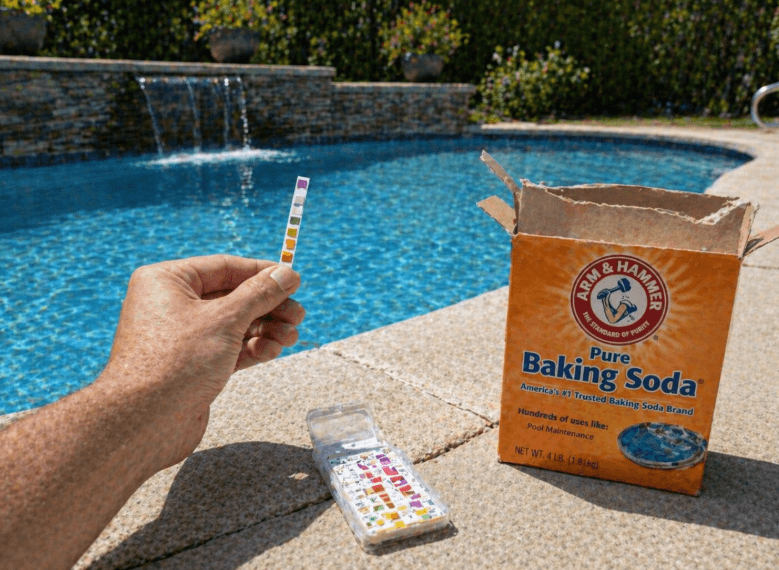
Its main job is very specific: it raises total alkalinity.
- Stabilizes your water balance- When alkalinity is low, your pH keeps jumping up and down. Baking soda acts like a buffer, helping your pool stay steady instead of constantly shifting.
- Prevents sudden pH swings- Without enough alkalinity, even small changes like rain or adding chlorine can throw your pH off quickly.
- Protects your pool surfaces and equipment- Low alkalinity can lead to corrosion, etching, or damage over time. Baking soda helps reduce that risk.
- Improves overall water clarity- When alkalinity is balanced, your filter and chemicals work better, which helps keep the water looking clean.
So, baking soda isn’t for everything. It’s for one job: fixing low alkalinity and stabilizing the pool.
Can You Use Baking Soda in a Pool?
Yes, you can. And it’s actually one of the most common ways to fix low alkalinity.
But here’s where people go wrong: they use it without checking what the pool actually needs.
- Regular baking soda works fine- You don’t need anything special. Standard baking soda is the same chemical used for pool alkalinity.
- Only use it when alkalinity is low- If your alkalinity is already in range, adding more can push it too high and create new problems.
- It’s safe when used correctly- It won’t damage your pool or harm swimmers when added in the right amount.
- It’s not a fix for every issue- It won’t solve cloudy water, algae, or low chlorine by itself.
Example: If your pool test shows alkalinity below the recommended range, then yes, baking soda is the right move.
If not, adding it “just in case” usually makes things worse.
How Baking Soda Affects Pool Alkalinity and pH
Baking soda mainly affects total alkalinity in pool water.
Its main job is to raise alkalinity directly. It can also raise pH slightly, but it does not raise pH as strongly as soda ash. That’s why baking soda is better for low alkalinity, not for quick pH correction.
Does Baking Soda Raise pH or Alkalinity in a Pool?
Yes, baking soda raises pool alkalinity directly.
It also may raise pH a little, but that is not its main purpose. If your pool has low alkalinity and unstable pH, baking soda can help make the water more stable.
But if your only issue is low pH, baking soda may not be the best choice.
Does Baking Soda Lower pH, Alkalinity, or Chlorine?
No, baking soda does not lower pH, alkalinity, or chlorine.
- It does not lower pH: It may slightly raise pH instead.
- It does not lower alkalinity: It raises alkalinity.
- It does not lower chlorine: It does not directly reduce chlorine levels.
Simple rule: baking soda raises alkalinity directly, raises pH slightly, and does not lower pH, alkalinity, or chlorine.
When to Use Baking Soda in a Pool
This is the part most people miss. They add baking soda too early, too late, or for the wrong reason.
Here’s when it actually makes sense:
- Your total alkalinity is below the recommended range (80–120 ppm): If your test shows low alkalinity, that’s your clear signal. This is the main reason to use baking soda.
- Your pH keeps bouncing up and down: If you fix pH and it shifts again quickly, low alkalinity is usually the cause. Baking soda helps stabilize it.
- After heavy rain or pool dilution: Rainwater can lower alkalinity over time. If your pool feels “off” after storms, test and adjust.
- After refilling or adding fresh water: New water can throw off your balance, especially alkalinity. That’s a common time to correct it.
- When your pool feels hard to manage: If you’re constantly adjusting chemicals and nothing holds, alkalinity is often the hidden issue.
Example: You adjust pH today, and it looks fine. Tomorrow it drops again. That’s not a pH problem, it’s an alkalinity problem. That’s when baking soda helps.
Bottom line: Use baking soda only when alkalinity is low or unstable.
📖 You May Also Like This “Swimming Pool” Article: How to Maintain an Inground Pool?
How Much Baking Soda to Add to a Pool
This is where people either underdo it or overdo it.
The amount depends on your pool size and how low your alkalinity is.
- General rule: About 1.5 pounds of baking soda raises alkalinity by ~10 ppm in 10,000 gallons of water
- Always test first: Don’t guess. Check your current alkalinity level before adding anything.
- Add in small amounts: Don’t dump everything at once. Add, circulate, then test again.
- Adjust gradually: It’s easier to add more later than to fix levels that are too high.
Example: If your pool is 10,000 gallons and alkalinity is 60 ppm, you’ll need around 3 pounds to bring it closer to 80 ppm.
Think of it like adjusting volume, not flipping a switch. Small changes work better.
How Much Baking Soda to Raise pH
- Not the best tool for raising pH alone- Baking soda slightly increases pH, but that’s not its main role
- Works when alkalinity is also low- If both pH and alkalinity are low, baking soda helps both at the same time
- Effect is gradual, not immediate- Don’t expect a big pH jump after adding it
- Use a different method for quick pH fixes- If your only issue is low pH, baking soda won’t give precise control
Example:
Low pH + low alkalinity → baking soda works
Low pH only → results may feel slow or inconsistent
How Much Baking Soda to Raise Alkalinity
- Use the 1.5 lb per 10,000 gallons rule- This is the easiest way to estimate how much to add
- Increase in steps of 10 ppm- Add enough to raise levels gradually, not all at once
- Let the pool circulate before retesting- Give it a few hours before checking levels again
- Avoid overshooting your target range (80–120 ppm)- High alkalinity creates its own problems
Example: 10,000-gallon pool at 50 ppm → about 4.5 pounds to reach 80 ppm
How Much Baking Soda by Pool Size
- 1,000 gallons- Around 0.15 pounds (2–3 oz) raises alkalinity by ~10 ppm
- 6,000 gallons- Around 0.9 pounds raises alkalinity by ~10 ppm
- 10,000 gallons- Around 1.5 pounds raises alkalinity by ~10 ppm
- 15,000 gallons- Around 2.25 pounds raises alkalinity by ~10 ppm
Quick tip: Start with a smaller dose, let it circulate, then test again. That’s how you stay accurate instead of overcorrecting.
How to Add Baking Soda to a Pool
This is where small mistakes can throw your water off. Dumping it all in one spot or adding too fast can cause uneven balance.
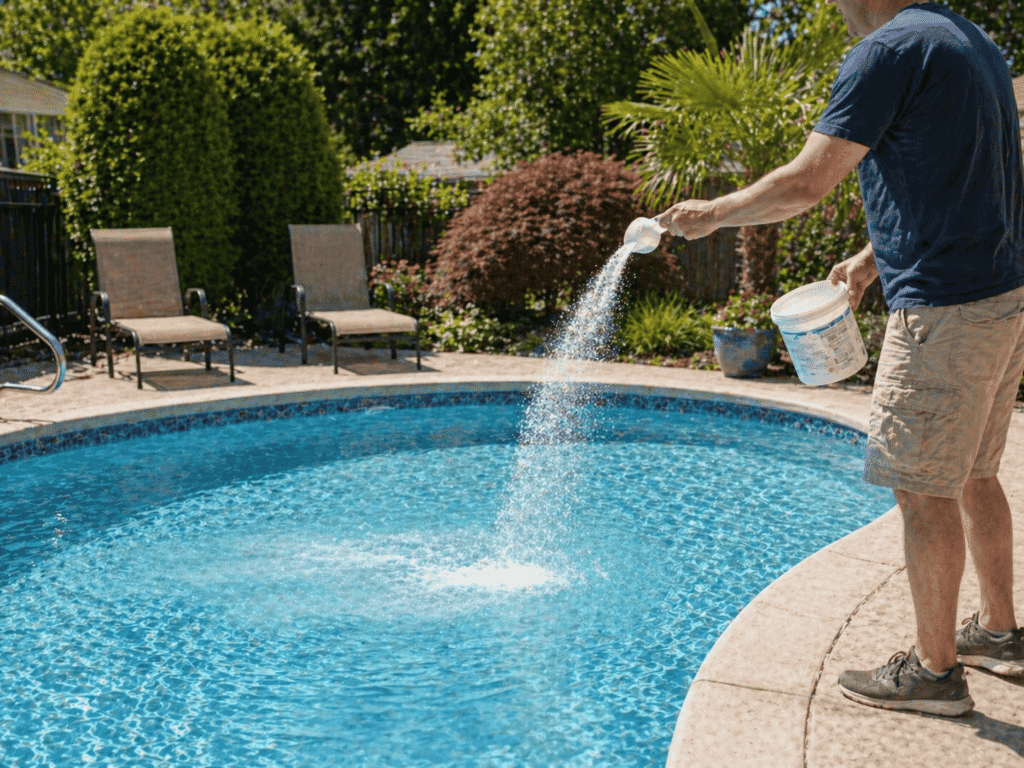
- Test your water first- Confirm alkalinity is low before adding anything. This step avoids unnecessary adjustments.
- Measure the right amount- Use your pool size and target level. Don’t guess or eyeball it.
- Spread it across the pool surface- Walk around the pool and sprinkle it evenly instead of pouring it in one area.
- Run the pump while adding- Circulation helps it dissolve and distribute properly.
- Brush lightly if needed- If some settles at the bottom, brush it so it dissolves faster.
Example: Instead of dumping 3 pounds in one corner, walk around and spread it slowly. That keeps the balance even across the pool.
How Long to Wait After Adding Baking Soda to a Pool
This is another common confusion. People either test too early or wait too long.
- Wait at least 4–6 hours before retesting- This gives the baking soda time to circulate and fully mix.
- Full balance can take up to 24 hours- Especially in larger pools or if circulation is slow.
- You can usually swim after a few hours- Once it’s dissolved and circulating, it’s generally safe.
- Keep the pump running during this time- Proper mixing depends on good circulation.
Example: Add baking soda in the morning, run the pump, and test again later in the day. That gives you accurate readings instead of guessing.
Can Baking Soda Clear Cloudy Pool Water?
This is where expectations go wrong.
- Baking soda does not directly clear cloudy water- It doesn’t kill algae or remove debris.
- It helps indirectly if alkalinity is low- Balanced alkalinity allows chlorine and filtration to work better.
- Cloudy water usually has other causes- Low chlorine, dirty filter, or poor circulation are more common reasons.
- Use it as part of the fix, not the only fix- You still need proper cleaning, filtration, and chlorine levels.
Example: If your pool is cloudy and alkalinity is low, baking soda can help stabilize things. But you’ll still need to clean and balance the rest.
What Does Soda Ash Do for a Pool?
Soda ash is often confused with baking soda, but they do different jobs.
- Raises pH quickly- This is its main purpose. It increases pH faster than baking soda.
- Also increases alkalinity slightly- But not as much as baking soda does.
- Used when pH is too low- If your pH drops but alkalinity is okay, soda ash is the better choice.
- Works faster but needs careful use- Adding too much can push pH too high quickly.
Example:
Low pH + normal alkalinity → soda ash works better
Low alkalinity → baking soda is the right choice
📖 You May Also Like This “Swimming Pool” Article: How to Properly Close Your Pool
How Much Soda Ash to Add to a Pool
This depends on how low your pH is and your pool size.
- General guideline- About 6 ounces per 10,000 gallons raises pH slightly (varies by condition)
- Always test before adding- Know your starting pH so you don’t overshoot.
- Add in small doses- Soda ash works fast, so it’s easy to add too much.
- Let it circulate before retesting- Wait a few hours before checking levels again.
Example: If your pH is low, start with a small amount, circulate, then test again. Adjust step by step instead of fixing everything at once.
Quick reminder: Soda ash is for raising pH quickly, while baking soda is for raising and stabilizing alkalinity.
How to Add Soda Ash to a Pool
Soda ash works fast. That’s helpful, but it also means mistakes show up quickly if you’re not careful.
- Test your pH before adding anything- Make sure the pH is actually low. Soda ash is only for raising pH, not general fixes.
- Pre-dissolve in a bucket of water- This helps prevent cloudiness or scaling when added directly.
- Pour slowly around the pool edges- Don’t dump it in one spot. Spread it evenly for better balance.
- Keep the pump running during and after- Circulation helps it mix properly and avoids uneven pH levels.
- Retest after a few hours- Soda ash works quickly, so check levels before adding more.
Example: Add a small amount, circulate, then test. If needed, adjust again. That’s how you avoid overshooting.
Frequently Asked Questions
Can I Shock a Pool After Adding Baking Soda?
Yes, but wait 4–6 hours after adding baking soda so it fully dissolves and circulates. This helps alkalinity stabilize, allowing chlorine shock to work more effectively and avoid uneven chemical balance.
How to Lower pH in a Pool With Baking Soda?
You can’t lower pH using baking soda. It actually raises alkalinity and slightly increases pH. If your pH is high, you need a different solution designed to reduce pH, not baking soda.